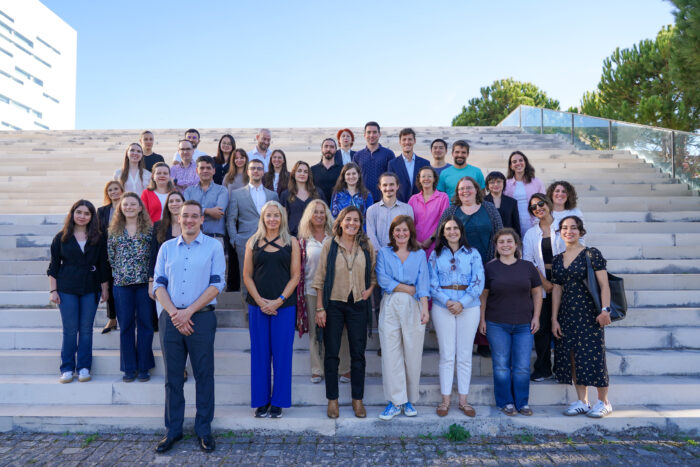


Babeș-Bolyai University participated in the EUTOPIA_HEALTH Hackathon, organised by NOVA University Lisbon, with representatives in two of the three teams awarded honourable mentions. The programme brought together researchers from the EUTOPIA_HEALTH consortium and non-academic partners to develop innovative and feasible solutions to real-world health challenges.
Eight multidisciplinary teams worked for more than a month on challenges proposed by Farmácias Hólon, EVITA-Cancro Hereditário and NTT DATA Portugal. Representatives from the partner organisations provided mentoring and practical insights, supporting the teams in developing their solutions.
The programme began with an online kick-off meeting on 16 September 2026, followed by two online mentoring sessions, and concluded with an on-site event in Lisbon on 27–29 October 2026.
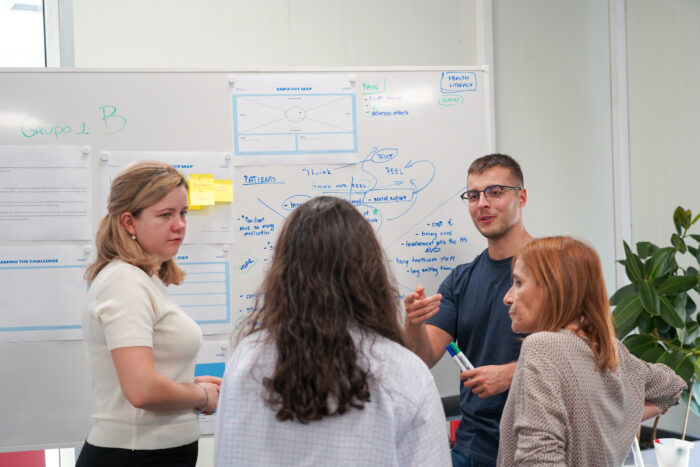

The first day, hosted at NOVA Information Management School, focused on Design Thinking methods, helping participants understand the challenges, identify opportunities and develop their ideas. On the second day, at NOVA Medical School, teams explored key innovation concepts, including stakeholder value, evidence generation, feasibility, differentiation and pitch preparation.
On the final day, each team presented its solution and answered questions from mentors and an independent jury. Projects were evaluated based on their relevance to the proposed challenge, feasibility of implementation, technological innovation and research potential.
Three teams received honourable mentions:
- Team B: Stefania Szeibert-Kerekes (Babeș-Bolyai University), Hasti Moghaddam (University of Gothenburg), Rosário Pinheiro (NOVA University Lisbon) and Črt Krebs (University of Ljubljana).
- Team D: Mahshid Sarafraz (CY Cergy Paris Université), Sofia Pereira (NOVA University Lisbon) and Ester Rodriguez (Universitat Pompeu Fabra).
- Team G: Yuxin Pu (Vrije Universiteit Brussel), Ana Maria Ichim (Babeș-Bolyai University), Noemi Bortolato (Ca’ Foscari University of Venice) and Max Lelie (Vrije Universiteit Brussel).
The hackathon provided opportunities for knowledge sharing, interdisciplinary collaboration and stronger connections between universities and non-academic organisations. UBB’s participation in two of the recognised teams highlights the university’s contribution to developing health solutions through international cooperation.